Simon Last is a co-founder of Notion and the core driving force behind Notion AI. He and another co-founder, Ivan Zhao, founded Notion in 2013, and the platform now has over 100 million users. In this interview, Simon recounts the complete journey of Notion AI, starting from the initial GPT-4 experience at the 2022 all-hands meeting in Mexico, through three or four failed attempts at a writing assistant, semantic search, and a general Agent, to the recent release of Custom Agent. He also shares how he works with coding Agents (personal record: one Agent ran continuously for 13 days), and how Notion’s mission has shifted from “a tool to help people do things” to “a tool to help people manage Agents.”
Interview source: No Priors Podcast, Episode 153, March 12, 2026, Host: Sarah Guo

Original video: https://www.youtube.com/watch?v=1dYThQgOyZU
-
1. Notion’s AI harness (the system layer built around large models) is rewritten from scratch approximately every six months. Many companies build one version and stop, which Simon considers a common mistake. -
2. Notion tried three or four times before creating a usable general Agent. Personal Agent was released in September 2025, and the autonomously runnable Custom Agent was released in February 2026. -
3. When used well, coding Agents produce more robust output than human-written code; when used poorly, the output is all garbage. The key lies in designing the verification loop, not “vibe coding.” -
4. Simon’s personal record is a coding Agent that ran continuously for 13 days without stopping. He assigns tasks before bed, aiming for the Agent to still be working when he wakes up. -
5. Notion designed new APIs specifically for Agents: pages use a custom Markdown dialect, databases use SQLite syntax, as the original JSON format was too verbose for Agents. -
6. Notion calls itself “the Switzerland of models”, not locking into any single model vendor, and has begun integrating Chinese open-source models. -
7. Notion’s mission has fundamentally shifted: from “creating the best tools for humans to directly do work” to “creating the best tools for humans to manage Agents to do the work for you“.
【1】The GPT-4 Moment in Mexico
Sarah asked Simon if it was true that Notion’s first encounter with GPT-4 was at a company all-hands meeting in Mexico.
Simon said that was in 2022. He had been following AI developments, but things only became “very, very real” when he got GPT-4 test access. He and Ivan both got an early interface similar to ChatGPT and immediately realized two things: first, the model was smart enough to understand relatively complex instructions and could help write and edit things; second, its knowledge was extremely deep and broad.
When we played with it, it became just instantly clear to both of us, okay, the time is now to start thinking about how to apply this. It’s only going to get better.
They immediately formed a short-term plan and a long-term plan. The short-term plan was obvious: a writing assistant within documents, selecting text for AI to rewrite or generate. The team formed a strike team and released it within two or three months. The long-term plan was bolder: create a general Agent, give it all the tools humans have in Notion, let it create databases, write documents, perform searches, and chain these together to complete longer tasks.
The short-term plan launched quickly. The long-term plan simply didn’t work back then.
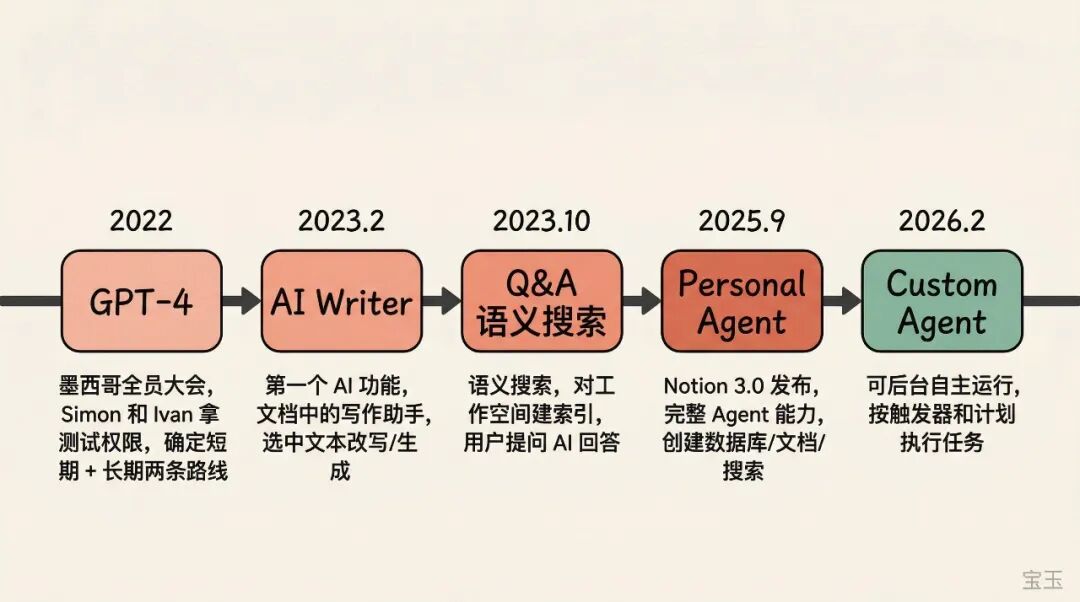
[Note: Simon and Ivan met through the Tools for Thought community on Twitter and founded Notion in 2013. Notion reached 100 million users in 2024, with ARR around $600 million in 2025 and a valuation of approximately $11 billion.]
【2】From Writing Assistant to Semantic Search
Notion AI’s first feature was AI Writer, opened to all users in February 2023. This was the easiest to implement: single-step tasks, rewriting and editing text, no retrieval needed, directly calling the model.
Next, the team started working on the Q&A feature: creating a semantic index for the entire workspace (i.e., converting text into vectors for semantic rather than keyword search), then letting users ask questions, with AI providing answers based on sources. This feature launched in October 2023 but was much more engineering-intensive, as it wasn’t just plugging into a large model but building a real-time updating index system and seriously setting up an evaluation framework to ensure quality.
After Q&A launched, Simon immediately realized the index should be extended beyond Notion, so they started integrating external data sources like Slack and Google Drive.
Sarah pressed: These platforms haven’t done their own search well either, why do you think you can do better?
Simon laughed: Yes, we’re also puzzled why most companies do indexing so poorly. His judgment is that the key lies in two things. First, having an AI-pilled savviness, a soaked-in intuition about what models can and cannot do. Second, craftsmanship and attention to detail. Each data source is different; you can’t use one approach for Slack and Google Drive, they are completely different types of information. You have to try many different queries, use it daily, and constantly iterate on chunking strategies and retrieval processes.
Sarah asked if the vastly different ways Notion workspaces are organized pose a big challenge for search.
Simon’s answer was somewhat counterintuitive: In the era of vector embeddings, the organizational structure of a workspace isn’t that important anymore. AI doesn’t care what your folder tree looks like; it only cares if a piece of text contains the information you need. He now even advises users: “Don’t stress too much about organization, just throw stuff in.”
Of course, technical decisions like chunking strategy (i.e., how to slice long documents into fragments for retrieval) are still crucial, but those are transparent to users and unrelated to how users organize their things.
【3】Rewriting Every Six Months
Sarah said Ivan insisted she ask one question: How many times have you rewritten your AI harness?
<p style="margin: 1.5em 8