Ramp is one of the fastest-growing corporate finance platforms in the US, valued at $32 billion, with over 50,000 customers and processing over $100 billion in annual transaction volume. At The Pragmatic Summit, Ramp sent a team of four to share their practical experience in the AI field over the past year: Executive Vice President (EVP) of Engineering Nik Koblov, Director of Applied AI Viral Patel, and two Staff Engineers, Will Koh and Ian Tracey.
They discussed five things: why they shifted from “building a bunch of agents” to “one agent + a thousand skills,” the entire process of taking the Policy Agent from zero to launch, how to define “correctness,” how to build internal AI infrastructure, and an internal coding agent that generates over 50% of PRs.
Original video link: https://www.youtube.com/watch?v=NMs8C2_3M0w
-
1. Last year, Ramp allowed teams to freely experiment with agents, resulting in four implementation approaches and five conversational interfaces. They ultimately concluded they should converge to an architecture of “one agent + a thousand skills.” -
2. The biggest source of errors for the Policy Agent is not the model itself, but insufficient context provided to the model. Context like employee seniority, receipt details, and merchant information is more effective than switching models. -
3. User approval behavior cannot be used as the standard for “correctness.” Ramp established a cross-functional team to label data weekly to define their own ground truth. -
4. Ramp’s internal coding agent “Inspect” generated over 50% of merged PRs in the current month, with users including non-engineering teams like product, design, legal, and marketing. -
5. The value of engineers in the AI era is not in coding speed, but in judgment: knowing what to build and knowing what’s wrong with what the AI builds.
The 15 Minutes Behind a Cup of Coffee
Nik Koblov opened with a scenario everyone can understand: a coffee purchase.
Buying a cup of coffee takes about 15 minutes of administrative time in the traditional process. Writing notes, categorizing it according to the company’s chart of accounts, finding and attaching the receipt, standardizing the merchant name into the company’s merchant database. These tasks accumulate at the company level.
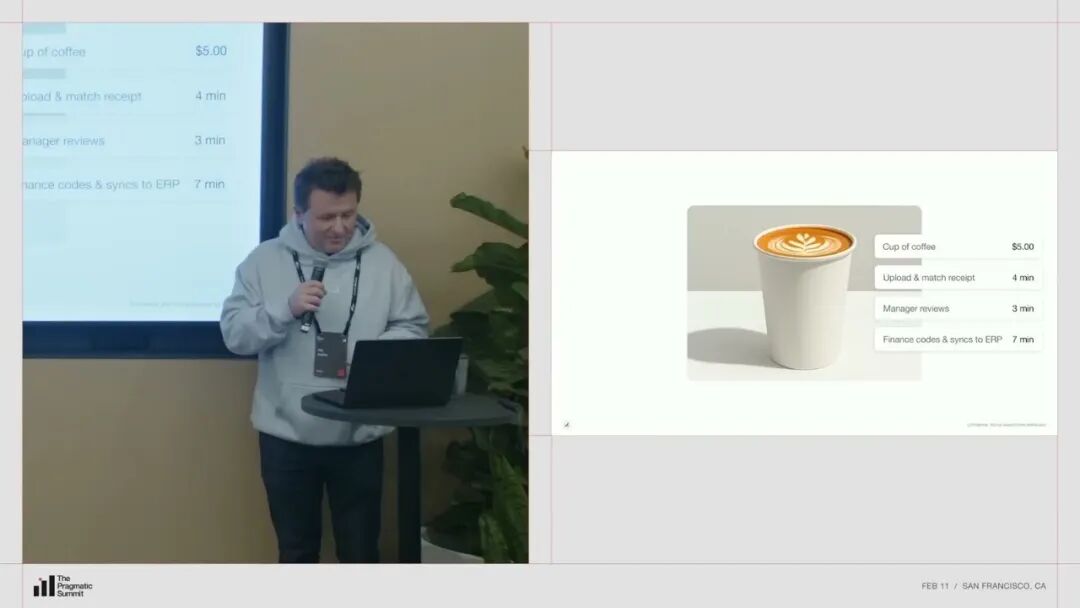 Nik Koblov used “a cup of coffee” to explain the most easily overlooked manual process costs in corporate finance.
The simplest way to understand what Ramp does is to compress those 15 minutes to near zero. From swiping the card to writing notes to categorization to receipts, everything is done automatically by the Agent. This is something Ramp started doing about three years ago, initially using AI for single-step processing, like standardizing merchant names and auto-writing notes. As model capabilities improved, the results got better.
But this was just the starting point. Almost every role on the Ramp platform does a lot of manual work: AP specialists process invoices, finance teams reconcile accounts, procurement teams compare prices, data teams run reports. Nik mentioned a detail: Ramp used to have a Slack channel called help-data where people would request data, and a poor soul would write SQL queries. This channel was replaced by AI about a year and a half ago.
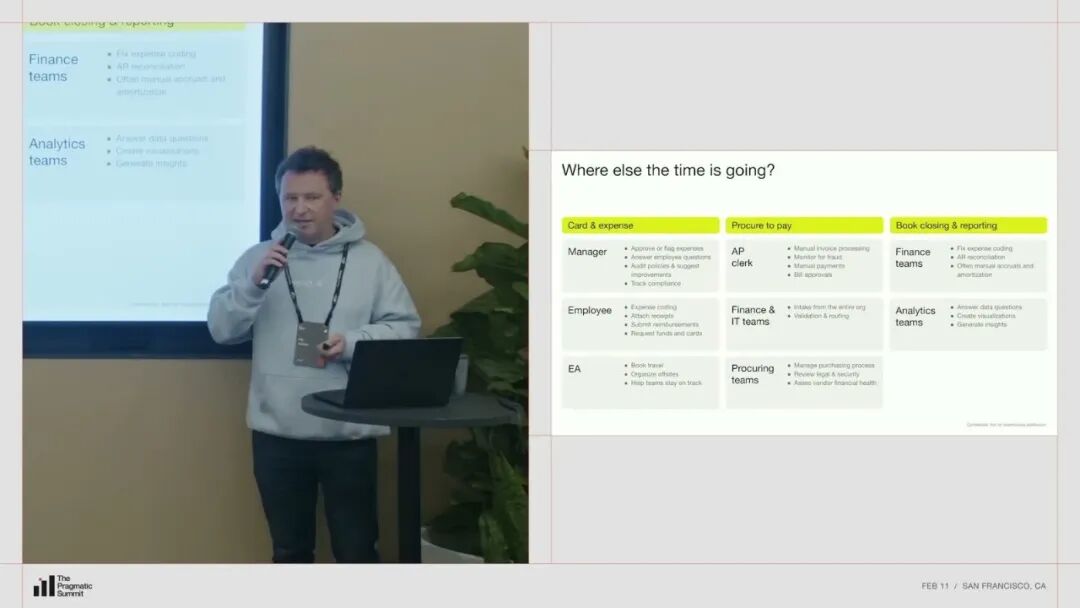 From card fees and procurement to closing books and analysis, Ramp tries to hand over these fragmented tasks scattered across teams to the Agent.
Don’t Build a Thousand Agents
Nik said Ramp is experiencing the most exciting paradigm shift in the software industry regarding AI. This shift requires a complete rethink and also means simplifying the tech stack.
The lesson they learned is:
You don’t need to build a thousand agents. Instead you want to drive your framework towards a single agent with a thousand skills.
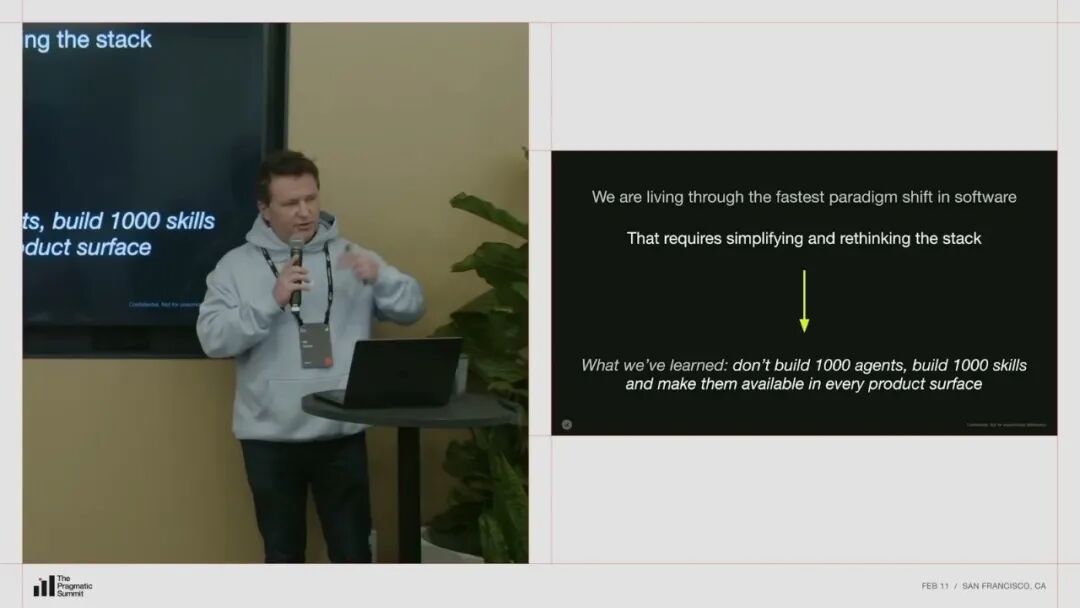 Ramp’s architectural judgment is straightforward: converge agents, expand skills.
Last year, Ramp intentionally let teams experiment freely. They found that internally, there were about four different ways to do the same thing, with several implementations each for synchronous and background agents. At the same time, conversational interfaces ballooned to five.
Now Ramp has converged all conversational interactions into a unified interface called Omnihat. Omni means “ubiquitous,” and it’s being deployed on every product interface. It works alongside traditional UX because you don’t always want to “talk” to software; sometimes forms and buttons are enough.
Nik showed an example: typing “Please help me onboard a new employee” in Omnihat. The Agent automatically parses the employee ID, queries the organizational structure through an HRIS tool, then finds a previously created workflow “New Employee Onboarding Handbook” and asks if you want to use this process for onboarding.
Behind this is a lightweight Agent framework built by Ramp, providing orchestration capabilities and tools. Engineers can quickly build new tools. Recently, a product manager built about 20 tools through vibe coding, completely without engineer involvement.
<img src="https://wechatrss.waytomaster.com/api/image?url=https%3A%2F%2Fmmbiz.qpic.cn%2Fsz_mmbiz_jpg%2FZlwY8rlDcFMPdQpyaVPGQuwYY30uAoC1P05uFCcVjAwWiaUPouknysaJ7dMGg0wvaHibNf5pY0tribexkhfaEP4bE0m7P8WLBHEQQ77N492Dicg%2F640%3Fwx_fmt%3Djpeg" data-src="https://wechatrss.waytomaster.com/api/image?url=https%3A%2F%2Fmmbiz.qpic.cn%2Fsz_mmbiz_jpg%2FZlwY8rlDcFMPdQpyaVPGQuwYY30uAoC1P05uFCcVjAwWiaUPouknysaJ7dMGg0wvaHibNf5pY0tribexkhfaEP4bE0m7P8WLBHEQQ77N492Dicg%2F640%3Fwx_fmt%3Djpeg" class="