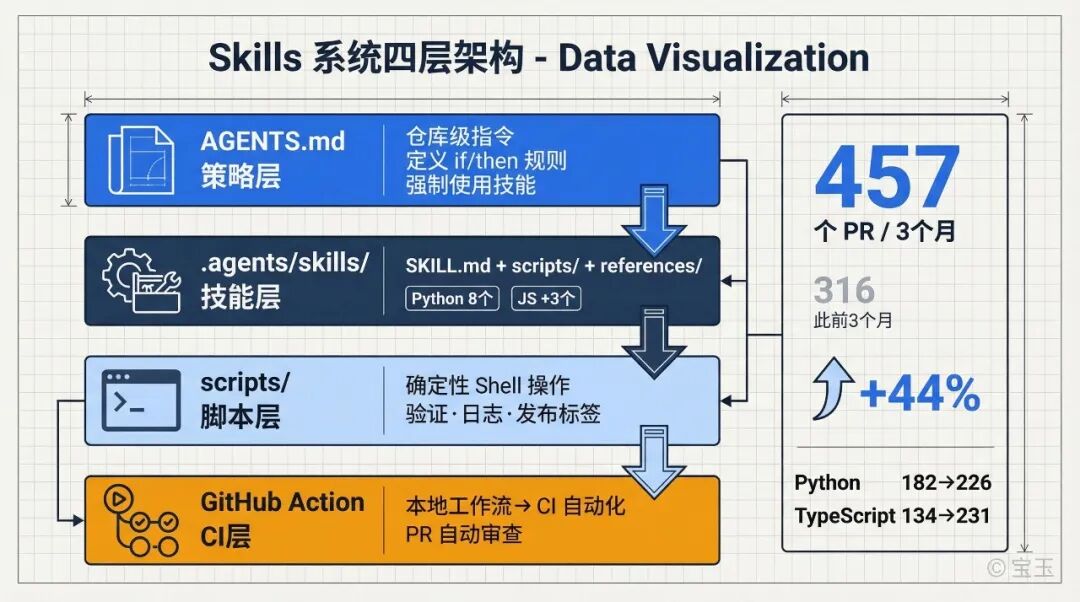
We transformed how we maintain the OpenAI Agents SDK[1] repository using Codex. Repository-local skills, the AGENTS.md file, and GitHub Actions allowed us to turn recurring engineering tasks—verification, release preparation, example integration testing, PR review—into repeatable workflows. Even with a fairly simple setup, this noticeably improved development velocity in these active repositories. Between December 1, 2025, and February 28, 2026, the two repositories merged 457 PRs, compared to 316 in the prior three months (September 1 to November 30, 2025) (Python: 182 → 226, TypeScript: 134 → 231).
Some context: The SDK comes in Python[2] and TypeScript[3] versions. It provides core components for building agent applications and is a concise way to build voice agents on top of the Realtime API[4], supporting multi-agent, tool calling, and human-in-the-loop (HITL) workflows. It’s widely used: as of March 6, 2026, the Python package had about 14.7 million downloads on PyPI in the last 30 days, and the TypeScript package had about 1.5 million downloads on npm.
The setup is simple:
-
• Repository policies are written in AGENTS.md[5] -
• Repository-local skills are placed in the .agents/skills/directory -
• Skills can contain scripts and reference materials internally -
• When the same workflow needs to run in CI, use the Codex GitHub Action[6]
This setup gives Codex stable context about how the repository operates, making repetitive engineering tasks faster and more accurate.
If you maintain a public open source project, check out Codex for Open Source[7]. Eligible maintainers can apply for ChatGPT Pro with Codex, API credits, and conditional access to Codex Security.
Keep Workflows in the Repository
In these repositories, we use skills to encapsulate repository-specific workflows. A skill is a small package of operational knowledge: a SKILL.md manifest file, plus optional scripts/, references/, and assets/ directories. The Codex customization documentation[8]explains why this works well: skills are well-suited for repeatable workflows because they can carry richer instructions, scripts, and reference materials without bloating the agent’s context upfront.
This aligns with the progressive disclosure model used by skills:
-
• First, only metadata like nameanddescriptionare visible -
• The full content of SKILL.mdis loaded only when the skill is selected -
• Reference materials are read or scripts are run only when needed
Both SDK repositories keep these workflows alongside the code:
-
• .agents/skills in openai-agents-python[9] -
• .agents/skills in openai-agents-js[10]
The Python repository is a leaner foundational version:
-
• code-change-verification—Runs required formatting, linting, type checking, and testing when code or build behavior changes. -
• docs-sync—Audits documentation against the codebase, finding missing, incorrect, or outdated docs. -
• examples-auto-run—Runs examples in automatic mode, generating logs and retry helper files. -
• final-release-review—Compares the previous release tag with the current release candidate to check release readiness. -
• implementation-strategy—Determines compatibility boundaries and implementation plans before editing runtime or API changes. -
• openai-knowledge—Pulls the latest OpenAI API and platform documentation via the official Docs MCP workflow. -
• pr-draft-summary—Prepares branch name suggestions, PR title