Just yesterday, OpenAI’s official account posted a brief farewell statement: “We have to say goodbye to Sora.” The app is shutting down, the API is shutting down, and even the planned video features to be integrated into ChatGPT are being scrapped.
Six months ago, the Sora app surpassed one million downloads in just five days after launch, faster than ChatGPT. Disney invested ten billion dollars in OpenAI, licensing over two hundred characters from Mickey Mouse, Marvel, Pixar, and Star Wars for Sora users to create videos. At that time, everyone felt the era of AI video had arrived, and OpenAI had won again.
Now Disney has also pulled out. A Disney spokesperson politely stated: “We respect OpenAI’s decision to exit the video generation business.” According to Reuters, Disney’s team was working with the Sora team the night before, only to be notified the next day of the other party’s “strategic pivot.”
First, look at the data. The Sora app did have a moment of popularity after its launch at the end of September last year:100,000 downloads on the first day, over a million in five days, once reaching the top of the US App Store overall chart. But the hype faded quickly.
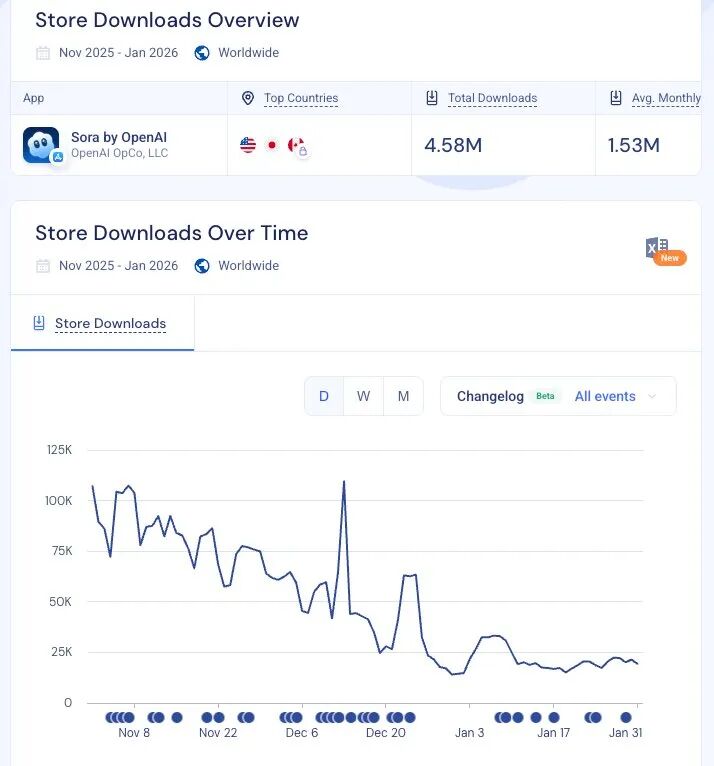
Image: Screenshot of Sora download overview on a third-party store data platform, showing approximately 4.58 million cumulative global downloads from November 2025 to January 2026.
Data from Appfigures shows thatdownloads fell 32% month-over-month in December last year, and plummeted another 45% in January this year, leaving only 1.2 million. User spending also dropped from a peak of $540,000 in December to $367,000 in January.The app’s cumulative revenue is only $1.4 million. Its ranking in the US App Store fell beyond the top 100.
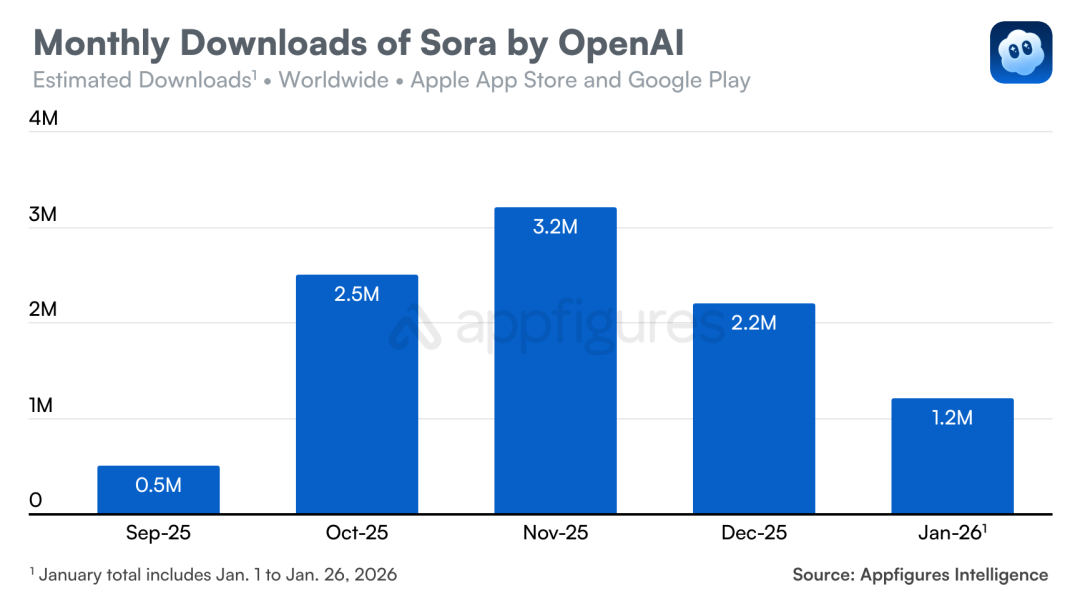
Image: Appfigures download data chart, published by TechCrunch.
For comparison, TikTok had over 18 million global downloads in December last year. Sora wanted to be the “AI version of TikTok,” but it turns out that AI-generated videos currently cannot sustain the daily consumption scenario of a social platform. Users found it novel for a few days, then put it down.
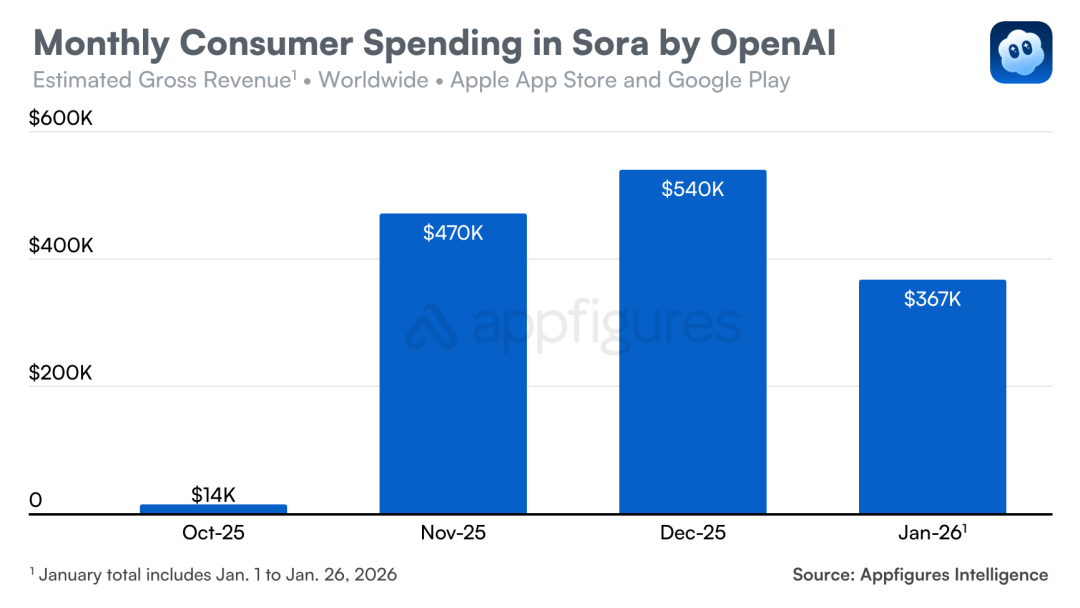
Image: Appfigures consumer spending data chart, published by TechCrunch.
Copyright issues have also been draining the product’s vitality. Initially, Sora adopted an “opt-out” system, meaning copyright holders had to actively request the exclusion of their works. As a result, users went wild creating videos with characters like SpongeBob SquarePants and Pikachu, causing an uproar in Hollywood. The Motion Picture Association, SAG-AFTRA union, and top actors like Bryan Cranston protested. OpenAI was forced to switch to a “licensing” system, which imposed more restrictions, and user interest declined accordingly.
The partnership with Disney was supposed to be a turning point, allowing users to legally use Disney characters, but data shows this collaboration did not revive user growth.
It’s Not Just Cutting a Product; The Whole Company is Pivoting
Sora’s shutdown is not an isolated incident. Over the past two weeks, OpenAI has made a series of moves:
On March 19th, OpenAI announced the merger of the ChatGPT desktop client, the coding tool Codex, and the browser Atlas into one “super app.” The head of the application, Fidji Simo, said in an internal letter: “We’ve spread our energy across too many apps and tech stacks. This fragmentation has slowed us down and prevented us from reaching the quality standards we want.”
Earlier the same day, Simo was even more direct at an all-hands meeting: “We cannot miss this moment because we are distracted by side quests. We must achieve excellence in productivity, especially on the enterprise side.”
Then came a bigger signal. The Information reporter Stephanie Palazzolo broke the news:OpenAI has completed pre-training of its next-generation large model, codenamed “Spud,” corresponding to GPT-5.5 or 6.0 level. Altman internally called Spud a “very, very strong model,” and the team believes it “can truly accelerate economic activity,” expected to launch within weeks.
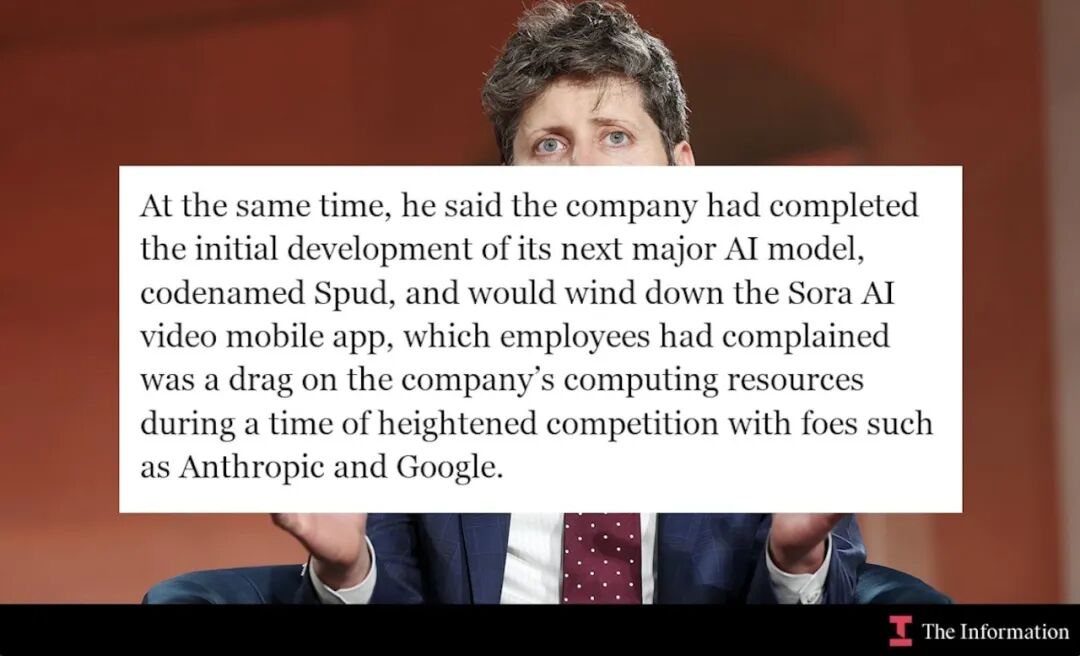
Image: Screenshot of The Information report. The report explicitly links the advancement of Spud with Sora being seen as a computational burden in the same assessment.
At the same time, Altman relinquished direct management of two key teams: the AI Safety team was transferred to Chief Research Officer Mark Chen, and the Information Security team was transferred to President Greg Brockman. Where did he redirect his own energy?“Fundraising, supply chain, and building data centers at an unprecedented scale.”
The Sora team was not disbanded but pivoted to long-term “world simulation” research, focusing on robotics. What was cut was the consumer-facing product; the underlying research capabilities remain.